How Much Does a WhatsApp AI Agent Cost Compared With Staff?6 min read
For many Nigerian businesses, WhatsApp is both the sales counter and the customer service desk. The WhatsApp AI agent cost question matters when staff spend hours answering routine enquiries, while customers still message after closing time. Yet automation is not automatically cheaper: setup, ongoing fees and human oversight all belong in the calculation.
Albanny Technologies helps businesses assess where AI can support existing teams. In this guide, you’ll learn how to compare staff and agent costs, what each option handles best, and how to estimate value without assuming guaranteed savings.
First, compare the full cost of a human workflow with the full cost of an AI workflow. A staff member’s salary is only one part of the expense. Recruitment, training, supervision, leave cover, power and work tools may also affect the monthly budget.
For a simple planning example, an SME might budget ₦120,000–₦180,000 monthly for a customer support role. These are illustrative figures, not a current salary survey. Actual pay varies by city, experience, hours and responsibilities. Add any employment costs your business pays before comparing options.
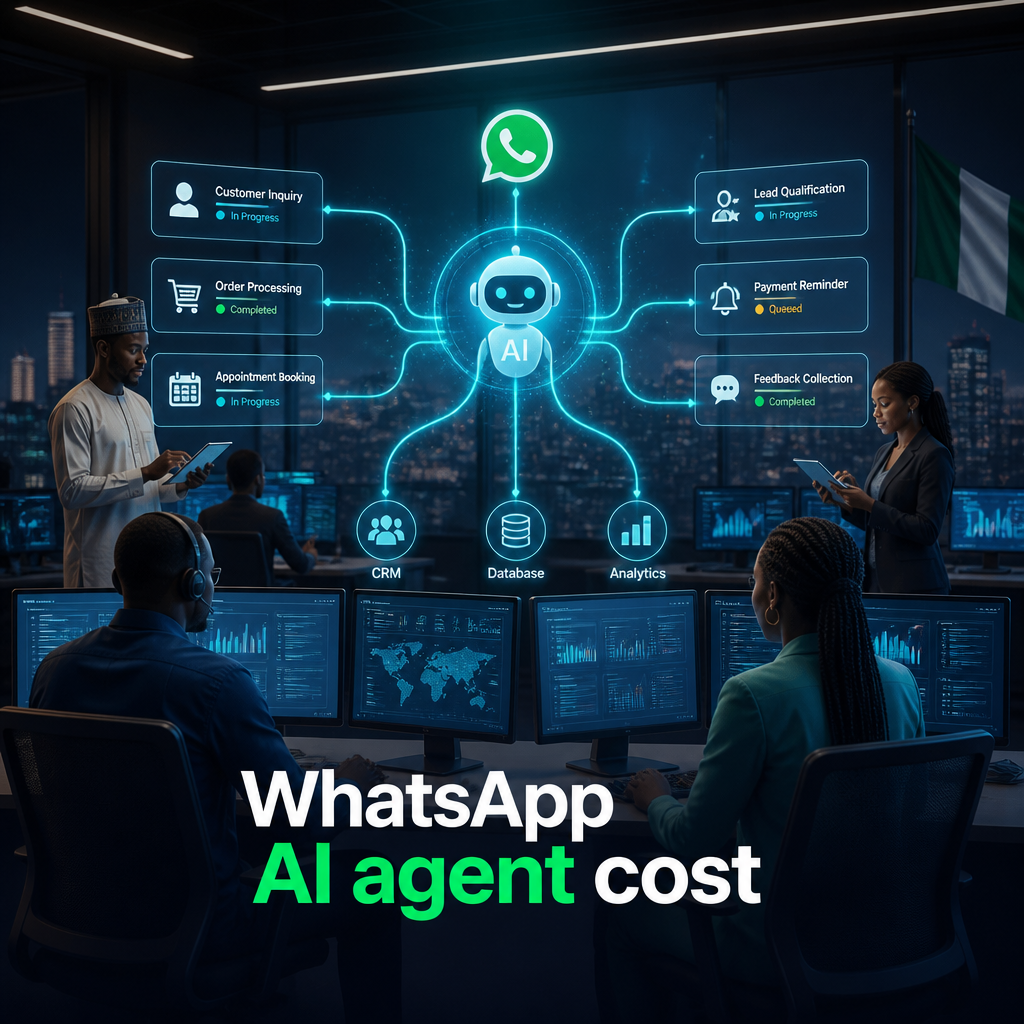
An AI agent has a different cost structure. You may pay for setup, a monthly platform plan, WhatsApp messaging charges, integrations and updates. The cost depends on conversation volume and what the system must do. For instance, answering opening-hour questions is simpler than checking stock or booking appointments.
WhatsApp’s official platform pricing information explains that business messaging charges depend on message categories and market rules. Therefore, ask providers which fees their quote includes. Also confirm whether setup, support, training and changes to your scripts cost extra.
To make the comparison fair, count the conversations that need answers, not every incoming message. If a team handles 500 chats a month, check how many involve repeated questions, appointment requests or basic lead details. Meanwhile, complicated complaints and unusual requests may still need staff.
The AI Automation complete guide offers broader context on selecting business processes for automation. In short, price the actual workflow, not the label “AI.”
Where staff still bring value
Human staff bring judgement, empathy and flexibility. For example, a customer who paid for delivery but received the wrong item may need a careful apology, a policy explanation and a practical resolution. An agent can collect details and route the complaint, but a person may need to approve a refund or make an exception.
Moreover, staff can notice context that a scripted process misses. A patient asking a clinic about an appointment may mention urgent symptoms. A trained employee can recognise when the conversation needs escalation instead of treating it as a routine booking.
However, manual handling has limits. One employee cannot respond to several chats at once with equal speed. During lunch, power interruptions or a busy sales period, response times can stretch. If customers message at night, the team may not answer until the next working day.
Count time as well as salary. For example, a real estate office might receive repeated questions about inspection dates, locations and required documents. If staff answer these individually, record the minutes spent each week. Then compare that time with the value of higher-priority calls and follow-ups they could handle instead.
“Automation should remove repetitive work, not remove responsibility,” is a useful principle for planning, as Albanny Technologies’ editorial team puts it. Therefore, define which enquiries staff can resolve, which the agent can answer, and which require a handover.
Pro tip: Review a sample of recent WhatsApp conversations before choosing a system. Group them by topic, urgency and outcome. That simple exercise shows whether repetitive enquiries make up enough of your workload to justify automation.
How an AI agent changes the calculation
An AI agent can answer approved routine questions, collect lead details, triage complaints and support appointment booking. As a result, staff may spend less time repeating basic information and more time resolving cases that need judgement. The agent does not eliminate the need for a responsible person to review its performance.
For example, a Lagos salon could use an agent to share service options, collect preferred dates and send appointment reminders. A small school could answer questions about application steps, then direct fee or safeguarding concerns to staff. In both cases, the business should test the workflow using real customer questions before launch.
To estimate the business case, use a basic monthly worksheet:
Count routine conversations and the average handling time.
Estimate the staff hours those conversations consume.
List the AI setup, subscription, messaging and support charges.
Include staff review time and any human handovers.
Compare the totals, then assess response coverage and customer experience.
Next, run a controlled trial with a limited set of questions. Track response times, completed bookings, qualified leads, escalations and incorrect answers. Avoid calling every automated conversation a saving. Instead, check whether the team gained usable time or served more customers without lowering service quality.
Finally, choose an agent that gives customers a clear route to a person. This matters when a customer has a sensitive complaint, a payment issue or a question the system cannot answer confidently. A well-designed handover protects trust and helps staff focus on the conversations that need them.
Key Takeaways
Compare full staff costs with setup, subscription, messaging and support fees.
Treat salary examples as planning assumptions, not guaranteed market rates.
Start by measuring routine WhatsApp volume and staff handling time.
Keep people responsible for sensitive, complex or unusual cases.
Trial the agent and track outcomes before expanding its role.
See How Abby AI Can Handle Routine WhatsApp Enquiries
The right choice depends on your message volume, enquiry types and service expectations. Albanny Technologies can help you assess the workflow and explore its AI automation services in Nigeria, including a practical next step for your team.
Benson is a Senior Digital Strategist at Albanny Technologies with over 5 years of experience in high-end web development and technical SEO. Specializing in helping Nigerian businesses scale their digital footprint, he translates complex technology into actionable growth strategies. When he’s not auditing site performance, he’s mentoring the next generation of tech talent in West Africa