Building Agentic WhatsApp Workflows with n8n and AI: The Abby AI Case Study16 min read
Abby AI agent and n8n agentic WhatsApp workflow by Albanny Technologies
How Albanny Technologies builds AI automation systems that connect WhatsApp, AI agents, business data, APIs, RAG, memory and real-world business processes
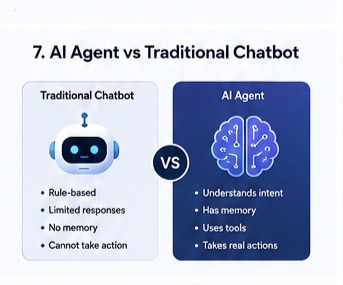
Businesses are moving beyond traditional chatbots.
A chatbot can answer a question. An AI agent can understand a request, retrieve information, make decisions, use tools, execute actions and hand the conversation to a human when necessary.
That difference is creating a new category of business automation: agentic workflows.
At Albanny Technologies, we are building toward this model with Abby, an AI-powered WhatsApp assistant designed to connect customer conversations with real business systems and processes.
Abby is not simply a chatbot that generates text.
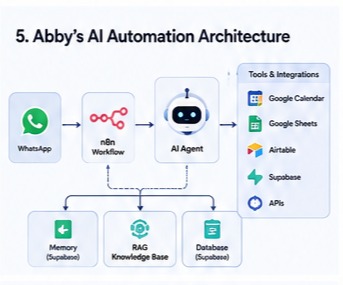
The architecture combines WhatsApp, n8n, AI, RAG, conversational memory, Supabase, Google Sheets, Airtable, Google Calendar and business automation tools into one orchestrated workflow.
This case study explains how that architecture works, why agentic automation is different from conventional chatbots, what we learned building Abby, and how businesses can apply the same principles to sales, customer support, operations and internal workflows.
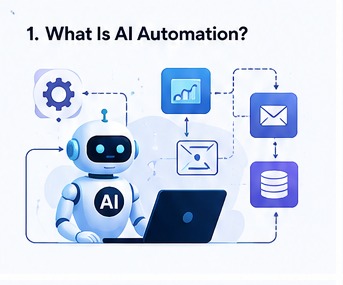
AI automation is the use of artificial intelligence together with workflow automation, business data, APIs and software tools to automate tasks that traditionally require human decision-making or manual intervention.
Traditional automation follows predetermined rules.
For example:
If a customer submits a form → send an email.
AI automation introduces a layer of interpretation.
For example:
Customer sends a WhatsApp message → understand the request → determine the appropriate action → retrieve relevant information → perform the action → verify the result → respond to the customer → record the interaction.
That is a fundamentally different type of automation.
Instead of automating only a sequence of predefined actions, AI automation can automate parts of the decision-making process.
This is where agentic workflows become particularly powerful.
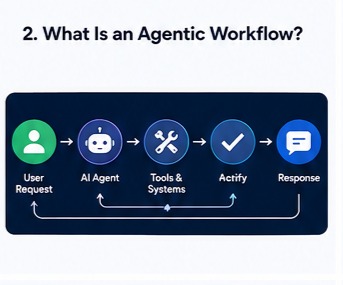
What Is an Agentic Workflow?
An agentic workflow combines an AI model with:
Context
Memory
Knowledge
Tools
APIs
Business systems
Workflow logic
Verification
Observability
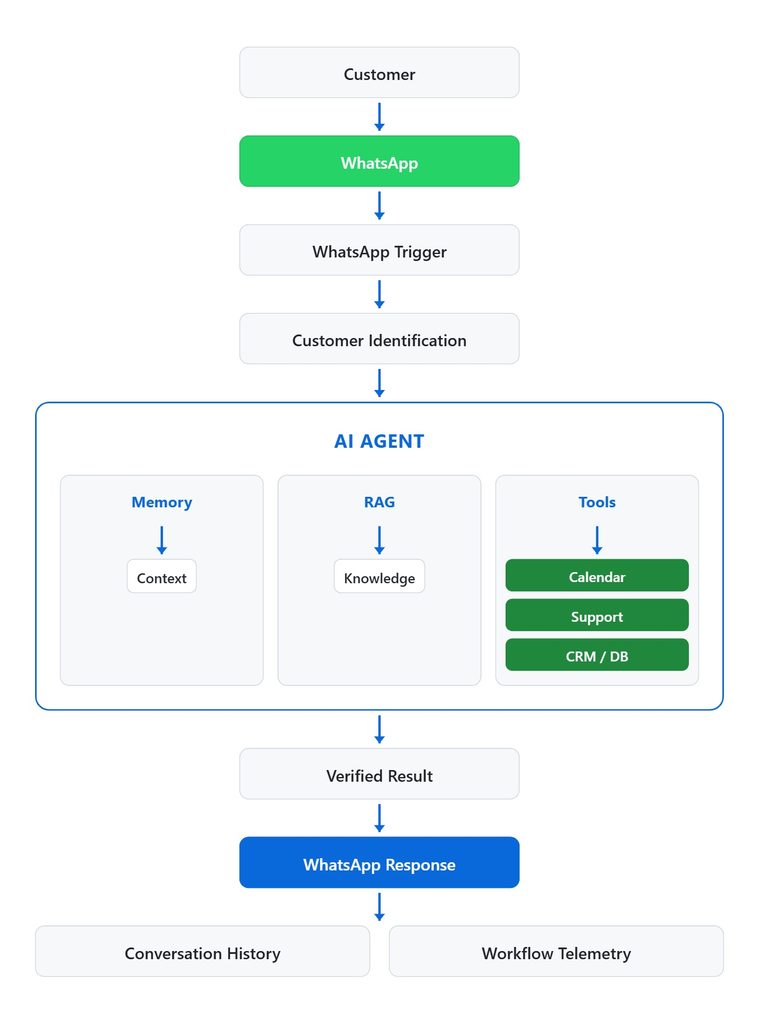
A simplified architecture looks like this:
The AI model is therefore one component of the system, not the entire system.
This distinction matters.
A language model can generate a convincing sentence saying:
“Your appointment has been booked.”
But an agentic workflow should be able to actually check the calendar, create the appointment and verify that the operation succeeded before telling the customer that the appointment exists.
That is the difference between AI-generated responses and AI-powered business automation.
Why WhatsApp Is an Ideal Interface for AI Automation
For many businesses, customers already communicate through WhatsApp.
That means businesses do not necessarily need to teach customers how to use another application.
The conversation itself becomes the interface.
A customer can write:
“I need a website for my business.”
Instead of sending the customer through a traditional contact form, an AI agent could:
Understand the enquiry.
Identify it as a sales lead.
Ask relevant qualification questions.
Retrieve information about available services.
Capture the customer’s contact information.
Store the lead in a CRM.
Recommend the appropriate service.
Schedule a consultation.
Notify the sales team.
Record the complete interaction.
The customer experiences this as a conversation.
Behind the scenes, however, an entire business workflow may be executing.
That is the real opportunity behind AI-powered WhatsApp automation.
The Abby AI Case Study
Abby was developed by Albanny Technologies to explore what happens when a WhatsApp assistant is designed as an agentic business workflow rather than a conventional chatbot.
The architecture was designed around several principles:
1. Understand the customer
Abby receives the incoming WhatsApp message and identifies the customer’s request.
2. Retrieve the right information
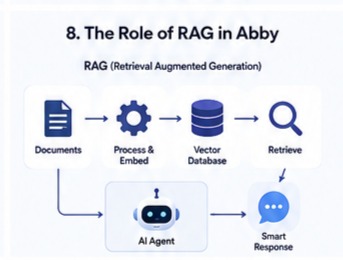
The agent can use a knowledge base and retrieval system rather than relying exclusively on information contained in the language model.
3. Maintain context
Conversation memory allows the agent to work with relevant previous interaction context.
4. Access persistent customer information
Important customer data is stored outside the model in structured systems.
5. Use business tools
The agent can interact with external systems such as calendars and support workflows.
6. Verify actions
Critical operations should be confirmed before Abby represents them as completed.
7. Record interactions
Conversations and workflow activity can be logged for operational visibility and analysis.
This architecture turns the WhatsApp conversation into an entry point for broader business automation.
Abby’s AI Automation Architecture
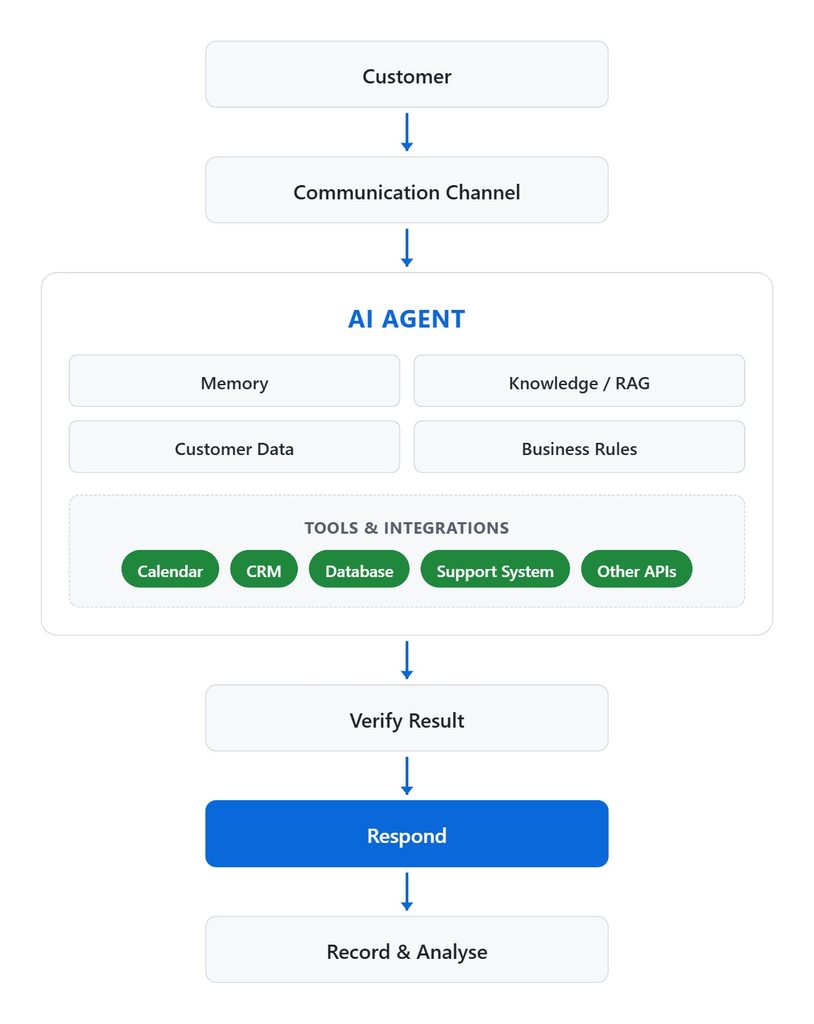
At a high level, the system looks like this:
The key architectural principle is separation of responsibilities.
The LLM handles reasoning and language.
The database stores structured information.
The vector store provides knowledge.
Memory provides conversation context.
n8n orchestrates the workflow.
External APIs execute business operations.
This makes the system easier to maintain, debug and expand.
Why We Use n8n for AI Automation
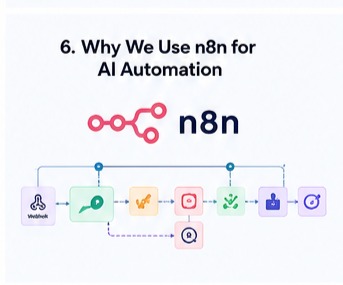
n8n provides an orchestration layer between AI models and business systems.
Instead of building every integration from scratch, workflows can connect an AI agent with databases, APIs, CRMs, communication platforms and other services.
For an AI automation system, this is particularly useful because the agent may need to interact with several systems during a single customer conversation.
For Abby, this allows company-specific information to exist outside the model.
Examples could include:
Services
Company information
Support procedures
Policies
Product information
Frequently asked questions
Internal documentation
This is particularly important for businesses because information changes.
Updating the knowledge source is generally more practical than continuously rewriting an enormous AI prompt.
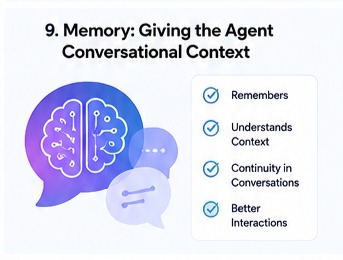
Memory: Giving the Agent Conversational Context
Knowledge retrieval and memory solve different problems.
Consider this conversation:
Customer:
My name is David.
Later:
Can you book me for Friday?
The agent needs to understand who David is within the conversation.
That’s memory.
But if David asks:
What services does Albanny Technologies provide?
The system needs knowledge retrieval.
That’s RAG.
A robust AI agent therefore needs to distinguish between:
What happened in the conversation?
and:
What does the business know?
That distinction becomes increasingly important as AI automation systems become more complex.
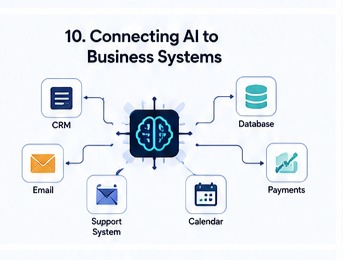
Connecting AI to Business Systems
This is where AI automation becomes commercially valuable.
An AI agent should not exist in isolation.
It should connect to the systems where business activity actually happens.
For example:
CRM
The agent can create or update customer records.
Calendar
The agent can check availability and schedule appointments.
Database
The agent can retrieve or update structured information.
Support system
The agent can create tickets and escalate issues.
Email
The agent can trigger notifications and follow-ups.
Payment infrastructure
Where appropriate and securely implemented, an agent can initiate or support payment-related workflows.
Analytics
Interactions can be recorded and analysed to identify customer behaviour and workflow performance.
This creates a bridge between conversation and operations.
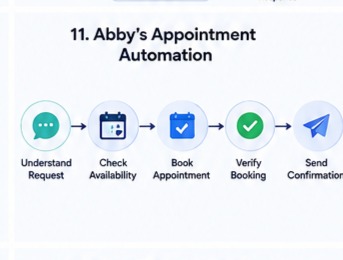
Abby’s Appointment Automation
Appointment scheduling is a good example of why agentic architecture matters.
A weak chatbot might respond:
“Sure, Friday at 2 PM works.”
But that does not mean the appointment actually exists.
A properly designed workflow should:
Step 1 — Understand the request
Identify date, time and purpose.
Step 2 — Check availability
Query the calendar.
Step 3 — Evaluate the result
If the slot is unavailable, do not book it.
Step 4 — Book
Create the actual calendar event.
Step 5 — Verify
Confirm that the booking operation succeeded.
Step 6 — Respond
Only then tell the customer the appointment is confirmed.
This principle can be summarized as:
Never let the AI claim that an external action happened unless the workflow has evidence that it happened.
That principle applies to bookings, tickets, payments, orders and other transactional workflows.
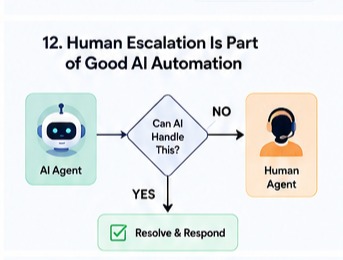
Human Escalation Is Part of Good AI Automation
A sophisticated AI agent should know when not to act autonomously.
Some requests require human intervention.
For example:
Complex complaints
Sensitive account issues
Unusual transactions
High-value sales opportunities
Legal or policy exceptions
Requests outside the agent’s authority
Instead of forcing AI to handle everything, the workflow can escalate.
The architecture becomes:
Customer ↓AI Agent ↓Can AI safely handle this? │ ┌──┴──┐ YES NO │ │ ▼ ▼Execute Human Escalation
This is an important principle of responsible AI automation:
Autonomy should be bounded by business rules and authority.
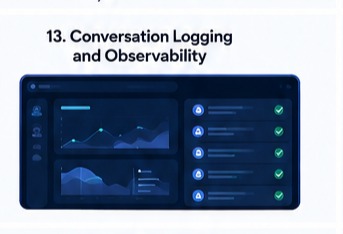
Conversation Logging and Observability
One of the lessons from building Abby is that successful AI responses do not necessarily mean successful workflows.
An AI agent could respond correctly while a database update, CRM synchronization or conversation-log operation fails in the background.
That is why production AI automation needs observability.
Abby’s workflow includes a conversation-history pipeline consisting of:
Format Conversation Log → Get Existing Conversation Row → Build Updated Transcript → Upsert Conversation Row.
The transcript builder retrieves the existing conversation, appends the latest user message and Abby response, and maintains the accumulated transcript.
The workflow also contains diagnostic tracing for execution IDs, intents, tools used, workflow steps, status, failed nodes and error information.
This kind of telemetry becomes essential once AI automation moves from experimentation into production.
The Difference Between AI Automation and AI Hype
There is a lot of discussion around AI agents.
But implementing an AI agent is not simply:
Connect ChatGPT to WhatsApp.
A production-grade system needs to answer much harder questions:
Where does customer data live?
How does the agent identify a customer?
What information can it access?
Which actions can it perform?
Which actions require approval?
How does it verify an action?
What happens when an API fails?
What happens when the AI misunderstands a request?
How is the conversation stored?
How are errors detected?
How are humans brought into the process?
How is the system monitored?
These are automation engineering questions, not simply prompt-engineering questions.
That is why successful AI automation requires a combination of:
AI + workflow engineering + software integration + data architecture + business process design.
Where Businesses Can Use Agentic AI
The same architecture used in Abby can be adapted to many business processes.
AI Sales Automation
An agent can:
Engage website or WhatsApp leads
Qualify prospects
Answer service questions
Recommend solutions
Capture lead information
Update CRM records
Schedule sales calls
Trigger follow-up workflows
AI Customer Support
An agent can:
Answer common questions
Search a knowledge base
Identify customer issues
Check ticket status
Create support tickets
Escalate complex problems
Record support interactions
AI Appointment Automation
An agent can:
Collect appointment requirements
Check availability
Book meetings
Send confirmations
Update calendars
Trigger reminders
AI Operations Automation
AI can also be used to interpret incoming information and trigger internal processes.
Abby demonstrates how these principles can be applied to WhatsApp using n8n, AI, RAG, memory, databases, APIs and business automation.
But Abby is only one implementation.
The broader opportunity is much larger.
Businesses can build AI-powered systems around their sales processes, customer support, operations, lead generation, scheduling, internal workflows and other repetitive processes.
At Albanny Technologies, we see AI Automation as the next layer of digital transformation: not replacing the software businesses already use, but connecting those systems with intelligent workflows that can help them work together more effectively.
If your business has repetitive tasks, disconnected systems, slow customer-response processes or workflows that still depend heavily on manual intervention, AI automation may be an opportunity worth exploring.
Ready to automate your business with AI?
Albanny Technologies designs and develops AI-powered automation systems, agentic workflows, WhatsApp AI agents, intelligent customer-support systems and business process automations.
Let’s identify where AI can create measurable value in your business.